
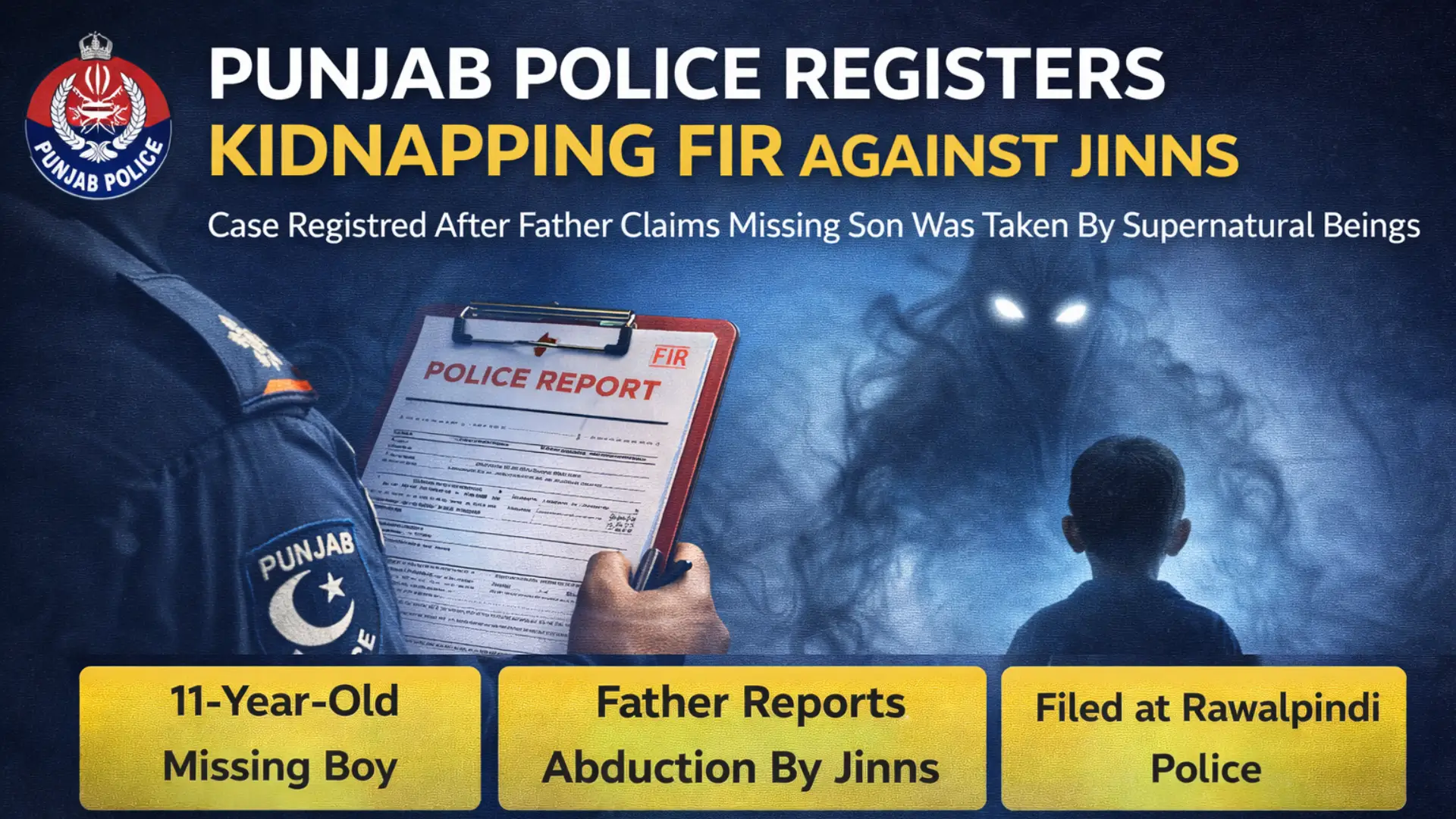

Punjab Police Registers Kidnapping FIR Against Jinns. In an unusual turn of events, Rawalpindi Police have registered a kidnapping case after the father of a missing child claimed that supernatural beings, or jinns, were responsible for his son’s disappearance. The case, which has caught the attention of both local and national media, was filed within the jurisdiction of Taxila Police Station, where the police formally recorded an abduction case against jinns following a complaint from the child’s family.
The incident took place on January 21, 2026, when 11-year-old Suraqa Al Saif went missing from his home. Despite the passage of several days, the child has not been located, prompting his father to file a police complaint on January 25, 2026. What makes this case particularly notable is the bizarre claim that the boy was abducted by jinns, a belief rooted in supernatural lore in parts of South Asia.
Allegations and Police Report
The father of the missing boy, in his complaint to the Rawalpindi Police, stated that his son, Suraqa Al Saif, left their home on January 21, 2026, but never returned. After waiting for several days, his father decided to file a police report on January 25, fearing the worst.
According to the FIR (First Information Report), the father alleged that his son’s disappearance was the work of jinns, supernatural creatures often mentioned in Islamic and South Asian folklore. The complainant stated that this was not the first time his son had disappeared, claiming that the boy had been taken by jinns in the past. However, the father also pointed out that his son had always returned home after being taken by these supernatural beings.

What sets this case apart from others, however, is the length of time that has passed since the boy’s disappearance. Unlike previous incidents where his son had returned after a brief period, Suraqa has been missing for days, leading his father to believe that this time, the supernatural forces had kidnapped him for a longer duration.
Supernatural Allegations and Police Action
The police report has raised several eyebrows due to its inclusion of supernatural beings as the alleged perpetrators of the crime. In Pakistan, while jinns are commonly mentioned in folklore and are part of cultural beliefs, the idea of them being involved in a real crime, such as kidnapping, is highly unusual.
Despite the unusual nature of the allegations, the Taxila Police officially registered the case and began investigating the disappearance. Officers are reportedly looking into both the potential for criminal involvement and the possibility of other supernatural explanations. However, the investigation has raised questions about how law enforcement handles such claims, especially when they involve elements that are outside the realm of legal and scientific reasoning.

The registration of the kidnapping case against jinns has captured the attention of the public and media, with many people expressing disbelief and skepticism about the police’s willingness to investigate the matter seriously. Some have questioned whether police time and resources should be devoted to investigating a case that involves supernatural beings, while others argue that the family’s belief should still be respected.
Similar Case in Lahore
This is not the first time that a kidnapping case has been linked to jinns in Pakistan. A similar incident occurred earlier in Lahore, where a married woman went missing, and her mother filed a police report accusing jinns of kidnapping her daughter. Like the case in Rawalpindi, the police took the complaint seriously and registered an FIR, though the case attracted significant media attention and skepticism.
The recurrence of these types of incidents has sparked debate about the role of cultural beliefs in criminal investigations. Many people in the region hold strong cultural and religious beliefs about jinns, which are deeply embedded in folklore. These supernatural beliefs often shape how certain situations are perceived and dealt with, especially in rural or suburban areas.

Role of Law Enforcement in Cultural Beliefs
The police’s decision to register cases involving supernatural beings, like jinns, has brought attention to the intersection of law enforcement and cultural beliefs. While the law is based on evidence, facts, and rational reasoning, the belief in supernatural entities remains prevalent in many parts of South Asia, including Pakistan.
The involvement of jinns in criminal cases raises important questions about how the police should respond to cultural and religious claims. Should law enforcement take these claims at face value, or should they be dismissed as superstition? The challenge for the authorities is to balance respect for cultural beliefs with the need for rational, evidence-based investigations.
In this case, while the police registered the kidnapping FIR, they are likely to face difficulties in gathering concrete evidence related to the claim of jinns. Investigators are expected to focus on practical aspects of the case, such as potential criminal suspects, while also being sensitive to the family’s cultural beliefs.

Reactions and Public Opinion
The unusual nature of this case has sparked a wide range of reactions from the public. Many people are skeptical about the idea that jinns could be responsible for a child’s disappearance. Some have criticized the police for taking the complaint seriously, arguing that it sets a dangerous precedent for future investigations.
On the other hand, some members of the public and cultural commentators have defended the family’s beliefs, emphasizing the importance of respecting local customs and religious views. In a country where jinns are frequently mentioned in folklore and religious texts, some argue that these cultural beliefs should not be dismissed outright, even when they appear to conflict with modern, scientific explanations.
Mystery of the Missing Child
As of now, the whereabouts of Suraqa Al Saif remain unknown. The police have not provided any significant updates on the case, and the investigation continues. The case has drawn attention not only due to the supernatural nature of the claims but also because it highlights the challenges law enforcement faces in dealing with cases that involve cultural beliefs and superstitions.

Whether the boy is found or not, the incident will likely remain in the public eye, prompting further discussions about the role of cultural beliefs in modern-day law enforcement. It also raises important questions about how law enforcement should address allegations that fall outside the traditional boundaries of criminal investigation.
Conclusion
The case of Suraqa Al Saif’s disappearance has brought attention to the complex relationship between cultural beliefs and law enforcement. The kidnapping FIR against jinns is an unusual and rare case, one that challenges the norms of traditional criminal investigations. While the authorities have chosen to proceed with the case, they will undoubtedly face obstacles in resolving the mystery.