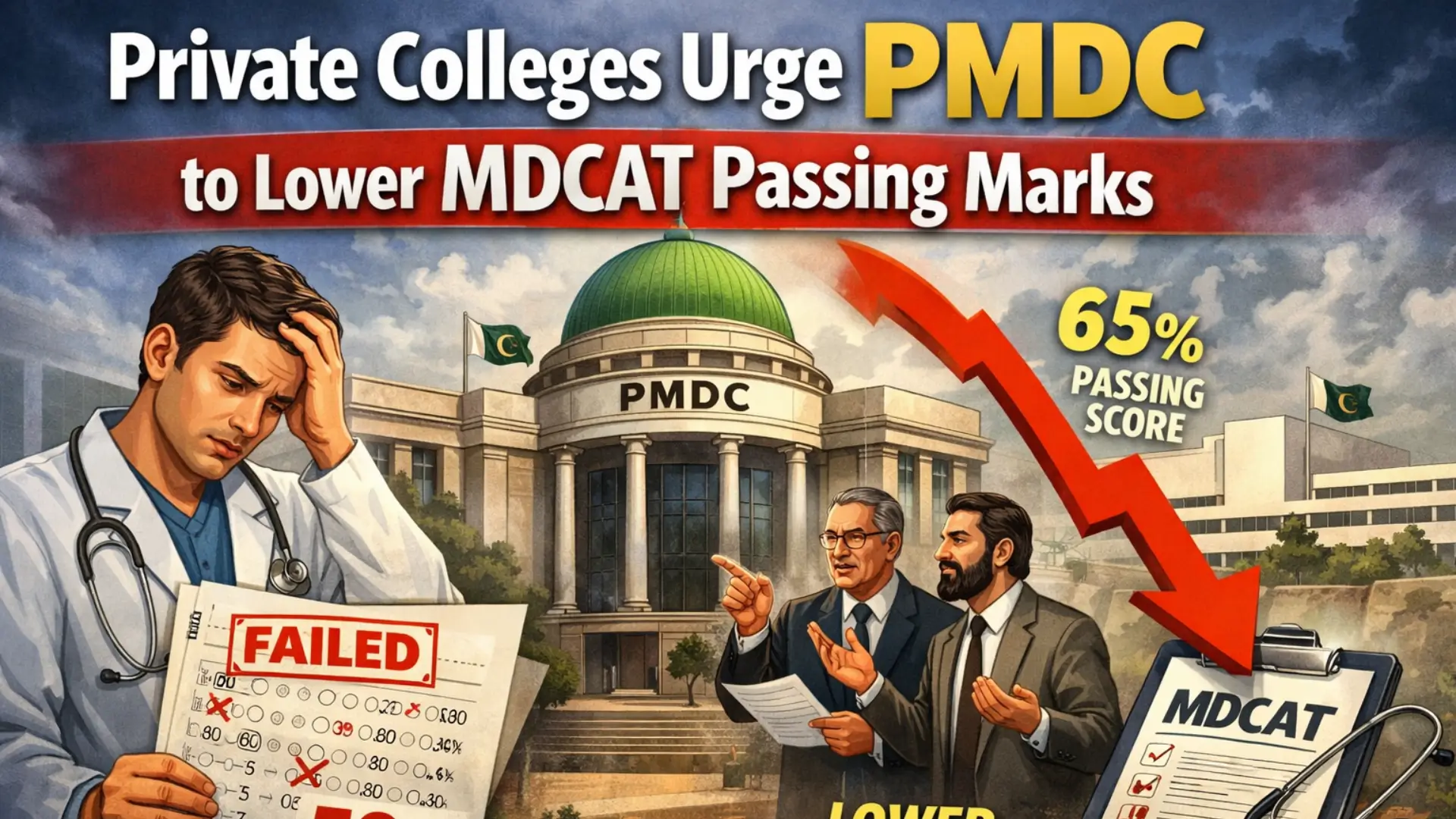

Private Colleges Urge PMDC to Lower MDCAT Passing Marks. Private medical colleges across Pakistan have urged the Pakistan Medical and Dental Council (PMDC) to reconsider the current MDCAT passing criteria after a large number of MBBS and BDS seats remained vacant for the 2025–26 academic session. University officials say that strict eligibility requirements have significantly reduced the number of qualifying candidates, leaving hundreds of seats unfilled despite multiple admission rounds.
The request highlights growing concern among medical institutions that unused seats could impact both academic operations and the future supply of healthcare professionals in the country.
SMBBMU Larkana Sends Formal Request to PMDC
The administration of Shaheed Mohtarma Benazir Bhutto Medical University (SMBBMU), Larkana has formally written to PMDC, asking the regulator to review and relax admission eligibility rules for medical and dental programs.
According to officials familiar with the development, the university registrar sent a detailed letter last month explaining that many applicants failed to meet the required MDCAT score and percentage criteria. As a result, hundreds of seats in private sector colleges could not be filled.
The university also confirmed that it has not yet received an official reply from PMDC regarding this request.
Hundreds of MBBS Seats Still Vacant
In its communication, SMBBMU reported that approximately 350 MBBS seats remain empty in affiliated private colleges. Even after repeated admission cycles and extended deadlines, institutions were unable to enroll enough eligible students.

Private medical and dental colleges also submitted separate representations supporting the request. They argued that the current merit thresholds are too high relative to this year’s MDCAT performance trends, resulting in a smaller qualifying pool.
College administrations warn that continued seat vacancies may create financial and academic challenges for institutions.
Current PMDC Eligibility Criteria
At present, PMDC has set the following minimum eligibility requirements:
- MBBS Admission: Minimum 55% marks
- BDS Admission: Minimum 50% marks
Students must also meet MDCAT passing standards along with academic percentage requirements. These criteria were introduced to maintain academic quality and standardization across medical institutions.
However, universities claim that this year’s applicant pool is weaker compared to previous sessions, making it difficult for many candidates to qualify.

Proposed Reduction in Passing Marks
SMBBMU has recommended a broader relaxation than what was granted last year. In its letter, the university proposed:
- MBBS eligibility reduced from 55% to 45%
- BDS eligibility reduced from 50% to 40%
This represents a 10 percentage point reduction in minimum required marks.
University officials argue that this adjustment would still preserve reasonable academic standards while allowing more students to qualify and secure admission.
Reference to Last Year Policy Relaxation
The letter also reminded PMDC that a similar situation occurred in the previous academic year. At that time, the council approved a 5% reduction in minimum eligibility marks for MBBS and BDS admissions.
According to SMBBMU, that temporary relaxation helped fill more seats and prevented institutional capacity from going unused. Admissions improved, and colleges were able to stabilize their academic schedules.
Based on that precedent, universities now believe that another relaxation — this time larger — is justified.
Impact on Medical Education Capacity
Medical universities warn that leaving seats vacant is not just an institutional issue — it also affects the broader healthcare education pipeline.
Key concerns include:
- Underutilization of available teaching resources
- Financial strain on private colleges
- Reduced number of graduating doctors and dentists
- Disruption in academic planning
- Long-term effect on healthcare workforce supply
Officials argue that when approved seats remain empty, the country effectively loses potential future medical professionals.
Link to Sindh Healthcare Needs
SMBBMU connected its request to the wider healthcare requirements of Sindh province. The university noted that reducing seat wastage is important for strengthening the future medical workforce.

With population growth and rising healthcare demand, institutions believe that training capacity should be fully utilized rather than restricted by unusually high cutoff thresholds during weaker performance years.
The letter emphasized that controlled relaxation — not removal — of standards can balance quality with practical needs.
Copies Sent to Key Authorities
To ensure transparency and coordination, copies of the request letter were also shared with several senior stakeholders, including:
- Sindh Health Secretary
- Vice Chancellor of Liaquat University of Medical & Health Sciences (LUMHS), Jamshoro
- Chairperson of the Provincial Supervising and Steering Committee
- Other relevant academic authorities
This indicates that the issue is being raised at multiple administrative levels, not just with the national regulator.
PMDC Yet to Respond
When contacted, SMBBMU Vice Chancellor Prof. Dr. Nusrat Shah confirmed that the letter requesting relaxation had been officially sent to PMDC. However, she stated that no formal response has been received so far.

Students and colleges are now waiting for PMDC’s decision, as any change in criteria could directly affect ongoing and upcoming admission rounds.
Debate Between Merit and Access
The situation has sparked debate within academic circles. Supporters of relaxation argue that:
- MDCAT difficulty varies each year
- Fixed high cutoffs can unfairly limit admissions
- Empty seats benefit no one
- Controlled flexibility is practical
On the other hand, critics warn that lowering thresholds too much may affect academic quality and professional standards. They stress that medical education requires strong foundational knowledge.
PMDC’s eventual decision will likely try to balance both concerns.
What This Means for Students
If PMDC approves the proposed reduction:
- More students may become eligible for MBBS and BDS
- Additional admission rounds could open
- Previously rejected applicants might qualify
- Private colleges may fill remaining seats
If rejected, current merit criteria will remain unchanged, and vacant seats may continue.
Students are advised to keep monitoring official PMDC and university announcements.
Conclusion
Private medical colleges are urging PMDC to lower MDCAT passing marks after hundreds of MBBS and BDS seats remained vacant. Universities argue that limited eligibility is restricting admissions and wasting capacity. A balanced relaxation, if approved, could support institutions, students, and future healthcare workforce needs across Pakistan.