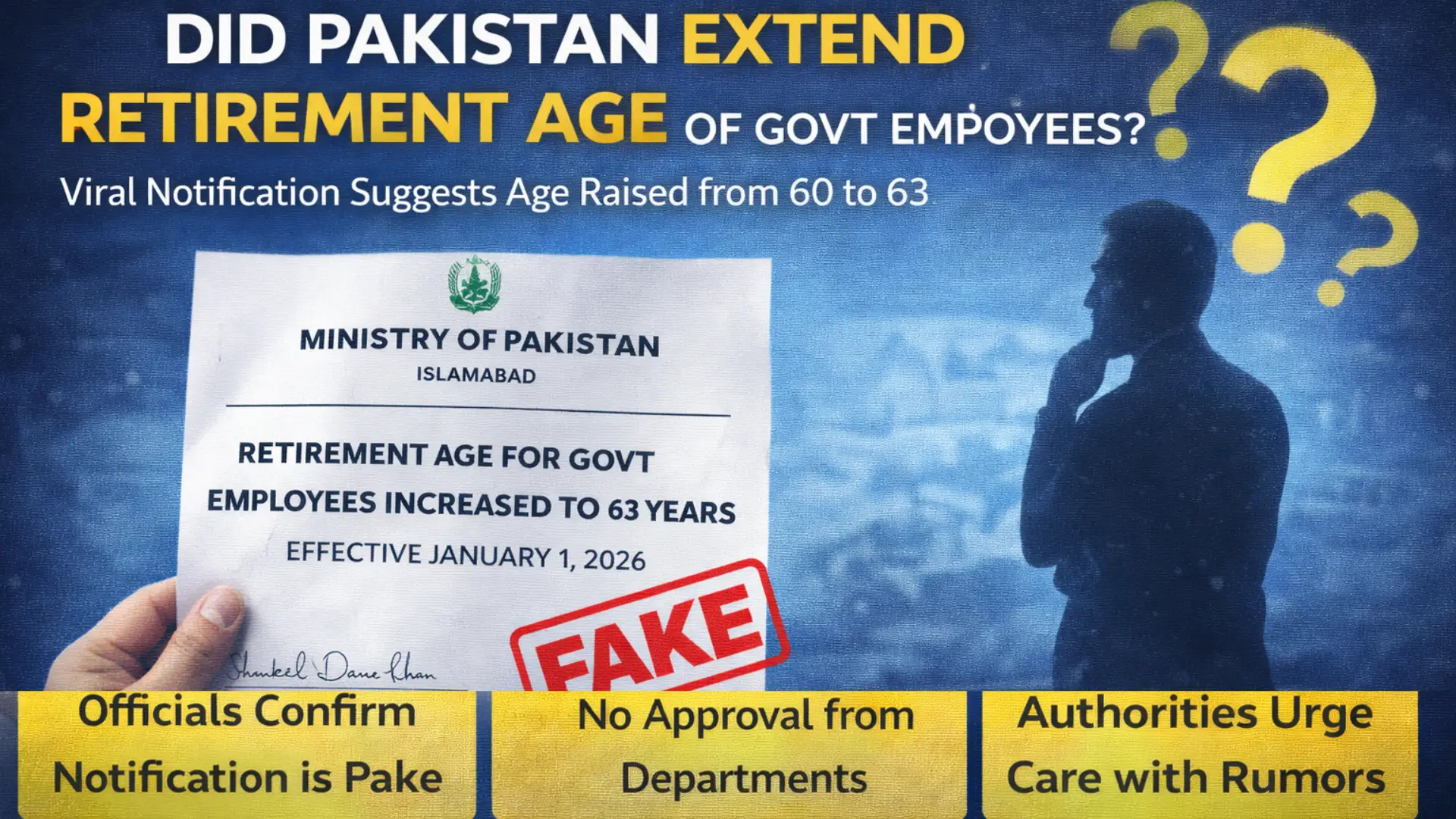

Did Pakistan Extend Retirement Age. A notification circulating on social media has caused confusion regarding whether the federal government of Pakistan has increased the retirement age of government employees from 60 to 63 years. The viral document, attributed to the Establishment Division, claims that the government decided to extend the retirement age by three years for federal employees, effective from January 1, 2026.
This claim has sparked intense discussions and debates among government employees and the general public. However, official sources have swiftly rejected the notification as fake and baseless, emphasizing that no such decision has been made.
Viral Notification and Its Claims
The viral notification circulated on social media created significant confusion. According to the document, which claimed to be issued by the Establishment Division, the Government of Pakistan decided to grant a three-year extension in the retirement age of federal government employees.
The notice purported that the decision would take effect from January 1, 2026, and that the retirement age would now be 63 years, as opposed to the previous 60-year limit. The document also included several details that seemed to lend it credibility, including references to the Finance Division and the Establishment Division, two important government entities involved in civil service policies.

Official Rejection of the Notification
Despite the wide circulation of the notice, official government sources have dismissed it as fake. Authorities from both the Establishment Division and Finance Division have confirmed that they have not issued any such notification regarding the increase in the retirement age.
Government officials pointed out several irregularities in the viral notification that raised doubts about its authenticity:
- Logo Confusion: The notice contained a logo that resembled the one used by Khyber Pakhtunkhwa—a province in Pakistan—rather than the official federal emblem used by the Establishment Division.
- Title of Ministry: The document mentioned the title “Ministry of Pakistan Islamabad”, which officials stated was incorrect and unusual.
- Forged Signature: The notice was signed by a person identified as Shakeel Qadeer Khan, Chief Secretary, Ministry of Pakistan. Authorities clarified that this was a forged signature and that no such individual holds the position mentioned in the notification.
- Fabricated Reference Numbers: The reference numbers linked to the Finance Division and Establishment Division were also found to be fabricated. No official records exist linking these reference numbers to any genuine government decisions.
Similar False Notifications in the Past
This incident is not the first time that fake notifications have been circulated on social media. False notifications and rumors claiming changes in government policies, including those related to employee retirement, have been spread in the past to create confusion and uncertainty.

Officials have urged the public to be cautious and not to believe everything they see on social media. They pointed out that fake posts like these often cause unnecessary panic among government employees and can lead to misunderstandings about official policies.
Why Do These Fake Notifications Circulate?
The purpose behind spreading such fake notifications is often to create confusion and stir up uncertainty, especially regarding critical issues like employee benefits, retirement, and wages. These messages sometimes exploit the fear and anxiety that employees may have about their jobs and financial security.
The timing of these false claims is often strategic, aiming to create chaos during periods when employees are expecting changes or updates regarding their work conditions. By spreading confusion, the creators of these notifications may attempt to manipulate public perception and divert attention from more significant or pressing issues.

Role of Social Media in Spreading Misinformation
Social media platforms have become a major tool for spreading both accurate and inaccurate information. While social media provides a space for people to stay informed, it also makes it easy for misinformation to go viral quickly.
Fake news and unverified claims can spread across social media platforms in minutes, gaining traction before the authorities have a chance to address them. Once these rumors take hold, it can take considerable effort to debunk them and restore public trust in official government sources.
How to Verify Information from Social Media
To avoid falling victim to misinformation, it is crucial for individuals to verify information through trusted sources. For government-related matters, the following steps can be helpful:

- Check Official Government Websites: Any important updates, such as changes in retirement policies or employee benefits, will be published on official government platforms or in the official gazette.
- Look for Authorized Notifications: Only official notifications issued by authorized government departments or officials should be trusted. Cross-checking the authenticity of documents before acting on them is crucial.
- Consult News Outlets: Reputable news outlets often confirm or deny major policy changes. Official announcements are typically covered in detail by established media sources.
- Verify Social Media Accounts: Government agencies and public figures usually have verified social media accounts with blue checkmarks. Any important announcements or updates will come from these channels.
Public Response and Concerns
Despite the official rejection of the retirement age increase, many government employees continue to express concern about the future of their retirement benefits. The viral notification sparked a conversation about the age of retirement and whether it should be extended to accommodate the needs of an aging workforce in Pakistan.
Some employees argue that extending the retirement age would help retain experienced professionals, especially in vital sectors like education, healthcare, and administration. On the other hand, others argue that maintaining a 60-year retirement limit is important to provide opportunities for younger workers and keep the workforce dynamic.
Need for Clear and Transparent Communication
This incident highlights the need for clear and transparent communication from the government regarding policy changes. Rumors and fake notifications can easily confuse employees and the general public, leading to unnecessary anxiety and mistrust.

Government agencies must ensure that any changes to important policies—such as retirement age, pay scales, and employee benefits—are communicated officially and unequivocally through authentic channels.
Conclusion
The recent viral notification claiming that the Pakistani government has increased the retirement age of federal employees from 60 to 63 years has been dismissed by official sources as fake. The Establishment Division and Finance Division have clarified that no such decision has been made, and the notification circulating on social media contains several irregularities that point to its fabrication.