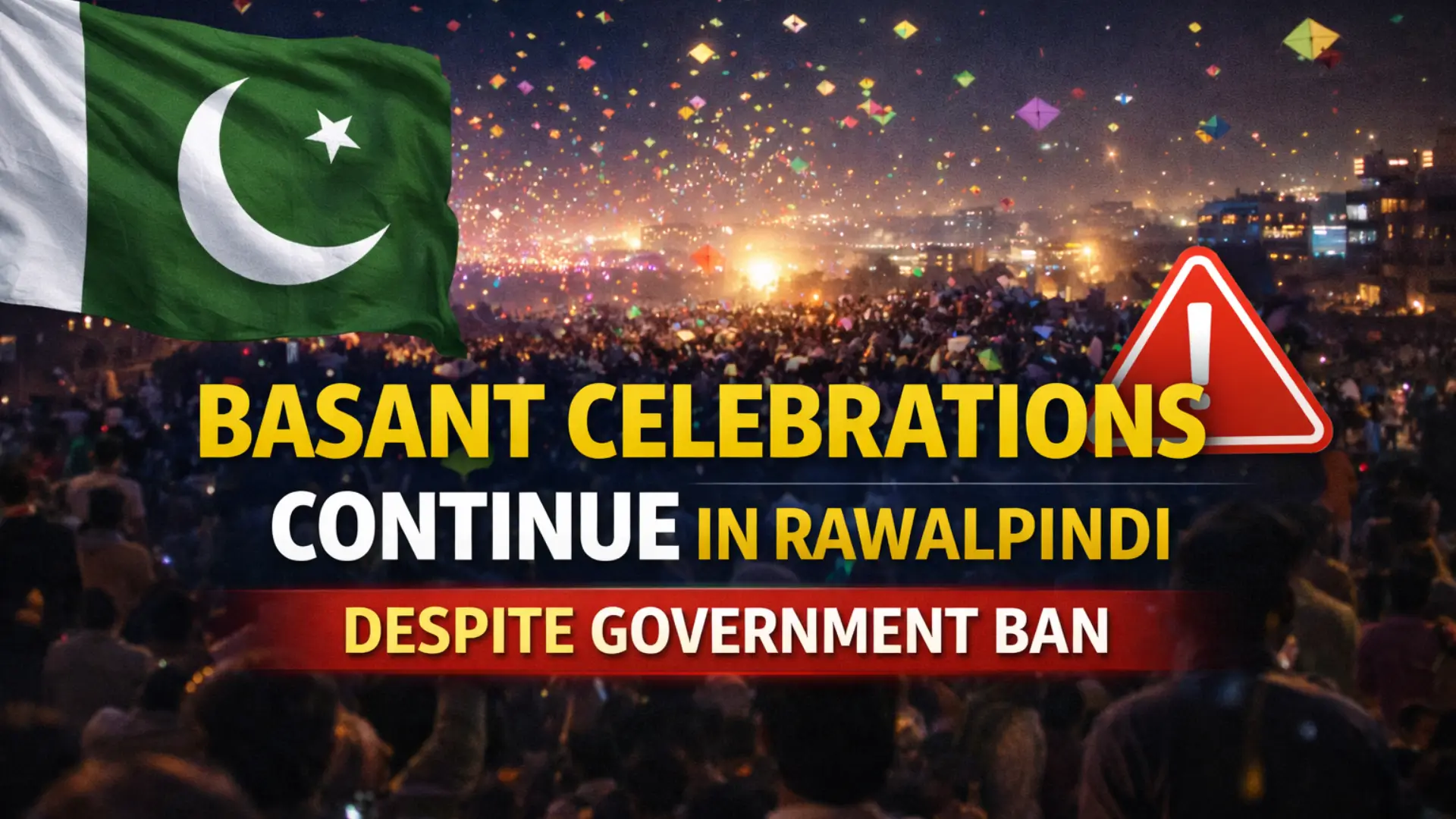

Basant Celebrations Continue in Rawalpindi. Despite a strict government ban, Basant celebrations were widely observed in Rawalpindi on Friday, as residents took to rooftops to fly kites and chant the traditional slogan “Bo Kata.” The festivities continued even as authorities warned about safety risks and launched police operations to curb violations.
The incident highlights the growing tension between public enthusiasm for Basant and government efforts to enforce restrictions due to safety concerns.
Residents Defy Kite-Flying Ban
According to reports, large numbers of residents across Rawalpindi openly defied the ban by flying kites from rooftops in different neighborhoods. The festive atmosphere was evident as families, especially young people, gathered on rooftops to celebrate the spring festival.
The celebrations continued despite repeated warnings from authorities about the dangers associated with kite flying, particularly the use of hazardous kite strings.
Injuries Reported During Celebrations
Authorities confirmed that several injuries were reported during the celebrations. At least seven people sustained cuts from sharp kite strings, commonly known for causing serious accidents during Basant festivities.

In a more serious incident, a 35-year-old man was critically injured after being struck by a stray bullet, allegedly fired during celebratory gunfire. The injured individual was immediately shifted to a local hospital for emergency treatment.
These incidents once again raised concerns about the safety risks associated with unregulated Basant celebrations.
Traffic Disruptions Across the City
Apart from injuries, Basant activities also led to traffic congestion in several parts of Rawalpindi. Children chasing stray kites on roads caused disturbances in busy areas, forcing motorists to drive cautiously.
Major localities including Raja Bazaar, Pirwadhai, and Sadiqabad witnessed significant traffic slowdowns. Motorcyclists, in particular, were advised to remain alert, as kite strings pose a serious risk to riders on open roads.

The disruption highlighted the broader impact of Basant celebrations on daily urban life.
Police Crackdown on Kite Sellers and Flyers
Law enforcement agencies carried out multiple operations to enforce the ban. Police registered cases against both kite sellers and individuals involved in flying kites. Several arrests were made during the crackdown.
Officials reported recovering hundreds of kites and reels of string during raids conducted across different markets and residential areas. Authorities reiterated that the ban was imposed to prevent accidents and maintain public safety.
Despite strict action, enforcement efforts appeared only partially effective as celebrations continued in many areas.

Online Kite Sales Fuel Celebrations
Interestingly, many residents reportedly turned to online platforms to purchase kites, bypassing strict enforcement in local markets. With physical shops under surveillance, online availability made it easier for enthusiasts to continue celebrating Basant.
This trend has created new challenges for authorities, as monitoring online sales is significantly more difficult compared to traditional markets.
Experts believe that the rise of online commerce may complicate future enforcement efforts if comprehensive digital monitoring mechanisms are not introduced.
Public Reaction and Claims of Discrimination
The Basant celebrations also sparked debate among residents. Some locals claimed that authorities were applying the ban unevenly, pointing out that limited Basant festivities were recently allowed in another major city.

These claims led to allegations of discrimination, with some Rawalpindi residents arguing that if celebrations could be permitted elsewhere under controlled conditions, similar allowances should be made for their city as well.
Such sentiments contributed to the public’s willingness to ignore restrictions and continue celebrating.
Government Stance on Basant Ban
The Punjab government has maintained a firm stance on the Basant ban, citing serious safety risks. Officials have repeatedly emphasized that hazardous kite strings, often coated with glass or metal, can lead to severe injuries and even fatalities.
In past years, multiple incidents involving motorcyclists and pedestrians have been linked to dangerous kite strings, prompting authorities to impose strict restrictions on the festival.

The government has reiterated that public safety remains the top priority, and the ban will remain in place unless safer alternatives are introduced.
Divided Public Opinion
Public opinion on the Basant ban remains divided. While many residents continue to celebrate the festival with enthusiasm, others support strict enforcement due to safety concerns.
Supporters of the ban argue that the risks associated with kite flying, especially in densely populated urban areas, outweigh the cultural significance of the festival. On the other hand, festival enthusiasts believe that Basant is an important cultural tradition that should be revived under proper regulations.
This divide reflects the ongoing debate between cultural preservation and public safety.
Conclusion
The continuation of Basant celebrations in Rawalpindi despite an official ban highlights the enduring popularity of the festival among residents. While authorities remain committed to enforcing restrictions due to safety risks, public enthusiasm for kite flying continues to challenge enforcement efforts.