
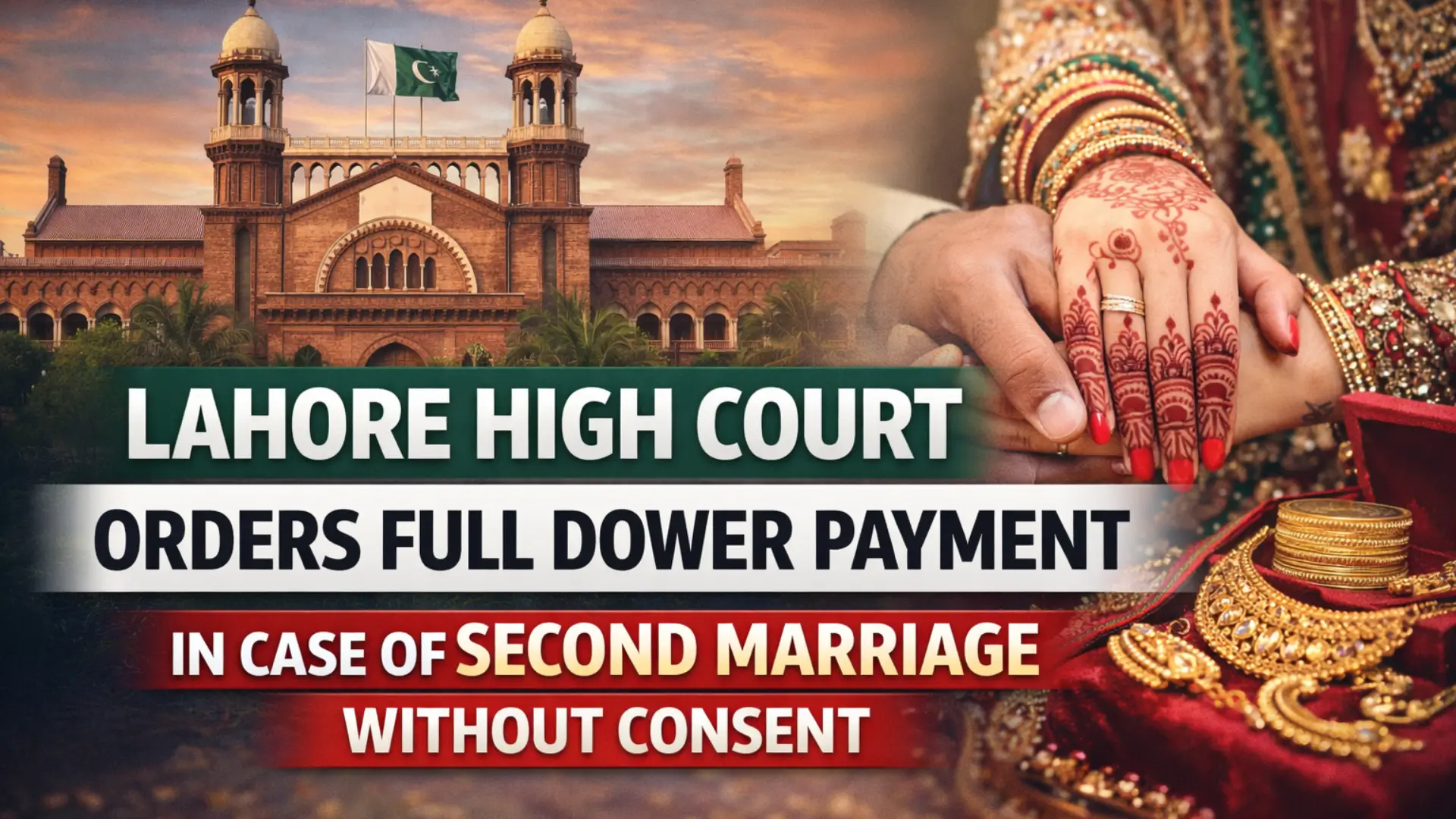

Lahore High Court Orders Full Dower Payment. In a significant legal ruling, the Lahore High Court has declared that a husband who enters into a second marriage without the consent of his first wife becomes immediately liable to pay her full dower (haq mehr) along with maintenance and dowry-related payments. The verdict is being seen as an important development in family law, reinforcing the financial rights of women under Pakistani legal frameworks.
The judgment highlights the legal consequences of contracting multiple marriages without fulfilling the conditions outlined in family laws, particularly regarding the rights and dignity of the first wife.
Details of the High Court Verdict
The decision was issued by Justice Abid Hussain Chatha, who heard a petition filed by Mehnaaz Saleem. The court reviewed and modified the rulings of lower courts, ultimately restoring and strengthening the petitioner’s financial claims.
According to the ruling, the husband was directed to:
- Pay Rs. 1,000,000 as full dower
- Provide monthly maintenance of Rs. 15,000
- Apply a 10% annual increase in maintenance starting from 2021
- Pay the assessed value of dowry items as determined by the court
The court emphasized that these financial obligations become enforceable immediately once a husband enters into another marriage without the first wife’s consent.

Background of the Case
The legal battle began after conflicting decisions were issued by lower courts. Initially, a family court had ordered the husband to pay the dower in installments and awarded approximately Rs. 1,005,000 for dowry items.
However, the case took a different turn when a sessions court later set aside the dower and maintenance payments and reduced the dowry compensation to Rs. 400,000. Dissatisfied with this decision, the petitioner approached the Lahore High Court seeking justice and restoration of her rights.
This appeal ultimately led to the high court’s detailed review and final ruling in favor of the petitioner.
Court Observations on Second Marriage Without Consent
While examining the case, the high court took serious notice of the husband’s actions. The court observed that he had contracted additional marriages without obtaining consent from his first wife, which is a crucial legal requirement under Pakistani family laws.

The bench also noted that the husband had allegedly forced the first wife out of the marital home, further strengthening her claim for financial relief and protection.
The court clarified that such conduct violates both legal and ethical responsibilities within a marriage and cannot be ignored by the judicial system.
Verbal Divorce Claim Rejected
Another important aspect of the ruling was the rejection of the husband’s claim that he had already issued a verbal divorce. The court held that verbal divorce alone does not fulfill legal requirements unless proper legal procedures are followed.
Since the alleged divorce was not legally valid, the court concluded that the marriage remained intact under the law. As a result, the husband’s financial responsibilities, including maintenance, remained fully enforceable.

This observation reinforces the legal principle that marital obligations cannot be avoided through informal or unverified claims.
Legal Implications of the Ruling
The high court made it clear that failure to obtain permission for a second marriage triggers immediate financial liability. The ruling establishes that a husband must bear full responsibility for:
- Immediate payment of dower
- Ongoing maintenance obligations
- Compensation for dowry items
Legal experts believe this judgment will serve as an important precedent in family law cases, especially those involving polygamy and women’s financial rights.
It sends a strong message that violations of marital laws will result in tangible legal consequences.

Protection of Women’s Financial Rights
The ruling is widely being viewed as a pro-women judgment that strengthens the enforcement of financial safeguards available to wives under Pakistani law.
By restoring the full dower and maintenance payments, the court reaffirmed that a woman’s financial rights are not symbolic but legally enforceable. The decision also highlights the judiciary’s role in preventing exploitation and ensuring fairness in marital disputes.
Experts believe that such judgments will encourage greater awareness among women about their legal rights and available remedies.
Impact on Future Family Law Cases
Legal analysts suggest that this verdict may influence future family court decisions across Pakistan, especially in cases involving second marriages and unpaid dower claims.

The ruling clarifies that courts will take a stricter view of husbands who attempt to bypass legal requirements when entering multiple marriages. It also emphasizes that lower court decisions can be revisited if they undermine established legal protections.
This could lead to more consistent enforcement of family laws and improved judicial protection for vulnerable spouses.
Conclusion
The Lahore High Court’s decision to order full dower payment in cases of second marriage without consent marks a major step toward strengthening women’s rights within Pakistan’s legal system. By holding the husband accountable for dower, maintenance, and dowry payments, the court has reinforced the importance of legal compliance in marital matters.