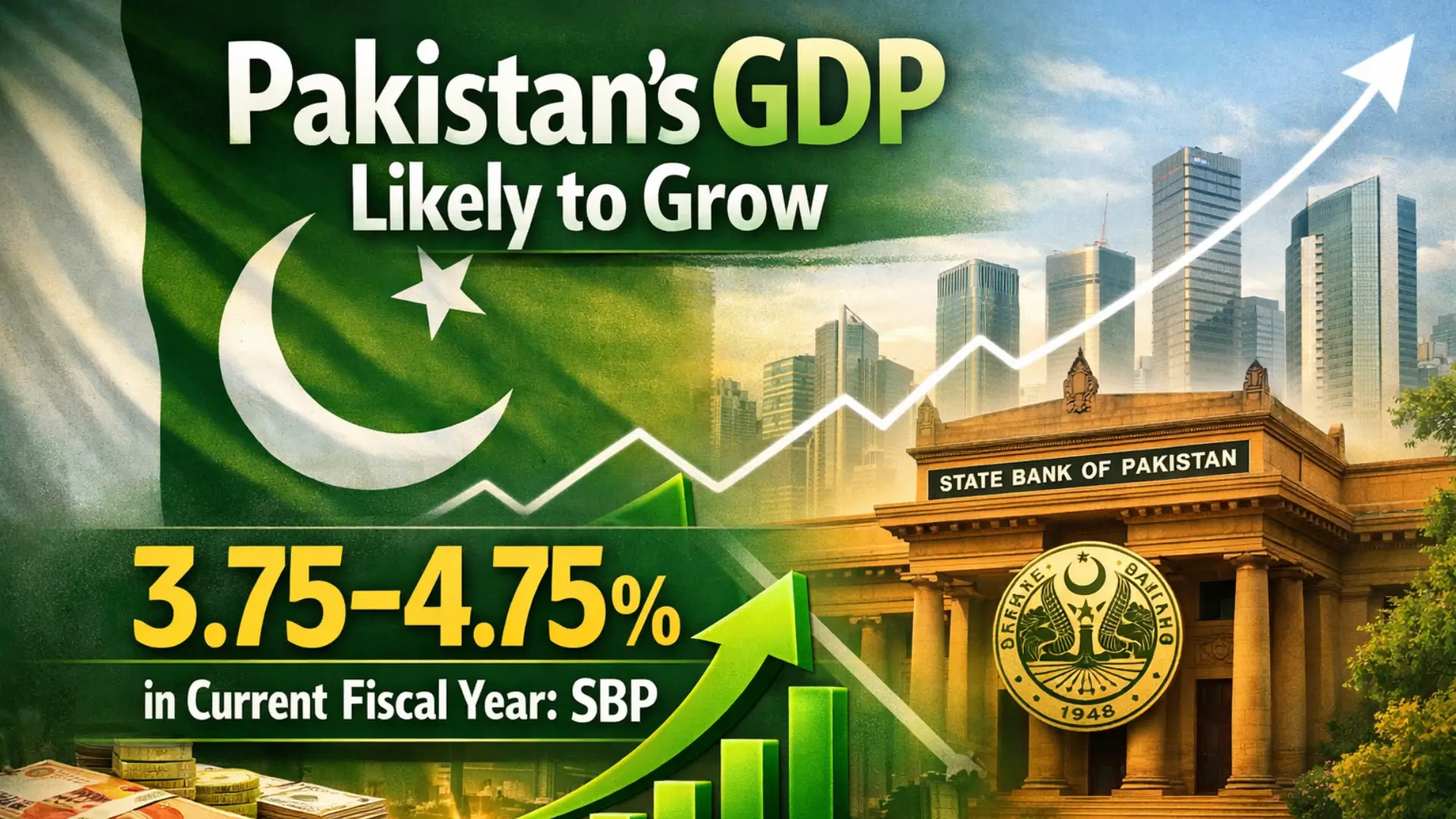

Pakistan GDP Likely to Grow 3.75–4.75%. Pakistan’s economic outlook has shown clear signs of improvement, as the State Bank of Pakistan (SBP) has projected real GDP growth between 3.75 percent and 4.75 percent for the current fiscal year FY26. The central bank further expects economic growth to strengthen in FY27, according to its bi-annual Monetary Policy Report.
This optimistic projection reflects improved macroeconomic stability, better fiscal management, and easing financial conditions, which have collectively supported economic activity across key sectors.
Improved Economic Stability Strengthens Growth Outlook
According to the SBP report, Pakistan’s economy is now in a much stronger position to absorb potential shocks from adverse global developments. This resilience is largely attributed to the build-up of fiscal and external buffers over the past two years, which has helped stabilize the country’s macroeconomic fundamentals.
The central bank highlighted that improved reserves, contained inflation, and coordinated monetary and fiscal policies have enhanced confidence in the economy and reduced vulnerabilities.
GDP Growth Gains Momentum in FY26
Economic activity has gained notable momentum during FY26. The report revealed that real GDP growth strengthened to 3.7 percent in the first quarter of FY26, compared to a modest 1.6 percent growth in Q1-FY25.

This sharp improvement signals a broad-based recovery and reflects increasing domestic demand, better supply-side conditions, and improved financial stability. The acceleration in growth has been driven by a strong rebound in both the industrial and agricultural sectors.
Industry and Agriculture Show Strong Recovery
The industrial and agriculture sectors have rebounded significantly, supported by relatively stable production costs, favorable supply-side dynamics, and easing financial conditions.
Despite some disruptions caused by floods, agriculture remained resilient, demonstrating the sector’s capacity to recover quickly. Improved availability of inputs and better policy support helped minimize the negative impact of climate-related challenges.
Meanwhile, the industrial sector benefited from stronger demand and improved access to financing, which boosted overall production activity.

Large Scale Manufacturing (LSM) Records Broad-Based Growth
The report highlighted a notable recovery in Large Scale Manufacturing (LSM) during FY26 after experiencing contraction in the previous fiscal year. Importantly, this growth has been broad-based, indicating a healthy and balanced industrial revival.
Strong production growth was recorded in:
- Automobiles
- Coke and petroleum products
- Wearing apparel (high value-added textiles)
- Construction-related industries
This resurgence reflects strengthening demand conditions and easing supply-side constraints across the economy.
Improving Business Confidence and Demand Conditions
The SBP noted that improving economic indicators point toward strengthening business confidence. Contained inflationary pressures, higher imports of intermediate and capital goods, and stable financial conditions have all contributed to increased production activity.

Higher imports of machinery and raw materials indicate expanding industrial capacity and renewed investment appetite, which are essential for sustained economic growth.
Role of Prudent Monetary and Fiscal Policies
The central bank emphasized that the current economic resilience is the result of prudent and well-coordinated monetary and fiscal policies. These policies have facilitated a sustainable pickup in economic growth without placing excessive pressure on inflation or the external account.
The recent reduction in the Cash Reserve Requirement (CRR) to 5 percent has also eased financial conditions, supporting credit growth and economic activity.
Inflation Outlook Remains Within Target Range
According to the Monetary Policy Report, inflation is projected to remain within the 5–7 percent target range during most of FY26 and FY27, despite some near-term volatility.

The SBP credited continued fiscal consolidation and a cautious monetary policy stance for maintaining price stability, which is crucial for long-term economic planning and investor confidence.
Need for Structural Reforms to Sustain Growth
Despite the improving outlook, the SBP stressed that productivity-enhancing structural reforms are essential to achieve higher and more sustainable growth. The report highlighted the need to:
- Increase exports
- Privatize or reform loss-making state-owned enterprises (SOEs)
- Improve efficiency across key economic sectors
These reforms are critical to strengthening the economy’s long-term resilience and competitiveness.
Risks to the Macroeconomic Outlook
While the risk of widespread damage from recent floods has receded, the SBP warned that uncertainty from global tariff-related developments and volatility in global commodity prices continues to pose challenges.

Domestically, below-target revenue collection and potential adverse climate events remain key vulnerabilities that could impact inflation, the external account, and GDP growth.
Conclusion
The State Bank of Pakistan’s projection of 3.75–4.75 percent GDP growth for FY26 reflects a cautiously optimistic outlook for the economy. Strengthening economic activity, recovery in key sectors, improved macroeconomic stability, and prudent policymaking have all contributed to this positive momentum.